
Chronologie Interactive

The Evolution of
la Mesure de l'Intelligence

Discover more than 140 years of scientific revolutions, from Galton's first hypotheses to the most sophisticated contemporary theories.

history_edu

Chronologie

Plus de 120 ans de science

  • Galton (1883)
  • Binet (1905)
  • Wechsler (1939)
1904

Charles Spearman

Le Facteur g

calculate

“General intelligence is a unique biological faculty.”

1905

Alfred Binet

L'Origine (France)
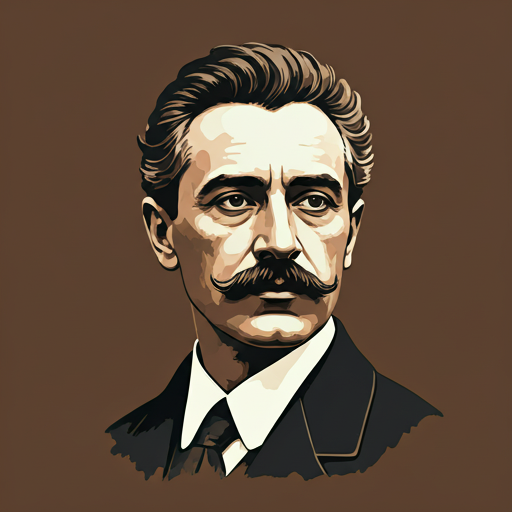
Alfred Binet portrait

First practical intelligence test for schoolchildren.

1916

Lewis Terman

Stanford-Binet

QI = (AM/AC) × 100
1917

Army Alpha/Beta

Mass Assessment

groups

Used to classify 1.7 million US recruits.

1939

David Wechsler

WAIS (QI Moderne)

analytics

Introduction of IQ by statistical deviation.

1983

Intelligences Multiples

H. Gardner
Les Grands Moments de l'Histoire

A detailed timeline of discoveries that transformed our understanding of human intelligence.

1884

Francis Galton and Biometrics

L'Anticipation

calculate

Cousin of Charles Darwin, Galton established the first "Anthropometric Laboratory" in London. It attempts to measure intelligence by sensory finesse and reaction time. Although his tests were imperfect, he revolutionized statistics by inventing thecorrelation et la regression.

1904

Charles Spearman & le Facteur g

La Fondation Statistique

functions

Spearman publishes groundbreaking research on general intelligence. It statistically demonstrates that if a person passes a logic test, they tend to pass all other cognitive tests. He calls this common mental energy the mythical"facteur g"– the general intelligence factor.

1905

The Binet-Simon Scale

La Naissance Pratique

school

Alfred Binet and Théodore Simon create thefirst objective methodto measure “Mental Age”. The objective was to identify children in need of special support in the French school system. Binet insisted that intelligence is not fixed and can be increased through education and training.

1912

William Stern & le "Quotient"

La Formule Magique

balance

German psychologist William Stern proposed a revolutionary change: divide mental age by chronological age to obtain a constant ratio. He invented the now universal acronymI.Q. (Intelligenz-Quotient). Cette formule simple transforme la mesure de l'intelligence.

1917

Army Alpha & Beta Tests

The Showdown

groups

During World War I, Robert Yerkes developed tests for the American army. The "Beta" was revolutionary because it wasnon-verbal, allowing illiterate or non-English speaking recruits to be tested. This is the start of large-scale collective testing: 1.7 million recruits tested.

1939

David Wechsler & le WAIS

Le Standard Moderne

analytics

Wechsler criticizes the concept of mental age for adults. He creates theIQ by deviation: we compare the individual to their age group, not to a fixed formula. A score of 100 becomes exactly the average. The WISC (children) and the WAIS (adults) remain the global benchmarks today, used in more than 70 countries.

1983 - Aujourd'hui

The Age of Multiple Intelligences

Enlargement

lightbulb

The emergence of theories such asIntelligences Multiples de Gardner, l'Emotional Intelligence de Goleman et la Sternberg's Triarchic Theoryquestioned the uniqueness of IQ. However, standardized psychometric tests remain the most accurate tool for predicting cognitive, academic, and professional success.

Fondamentaux

Pourquoi mesurer
l'intelligence ?

At the beginning of the 20th century, school became compulsory. The challenge was to objectively identify students in need of special support. What began as an educational tool became the basis of modern psychometrics and influenced global education.

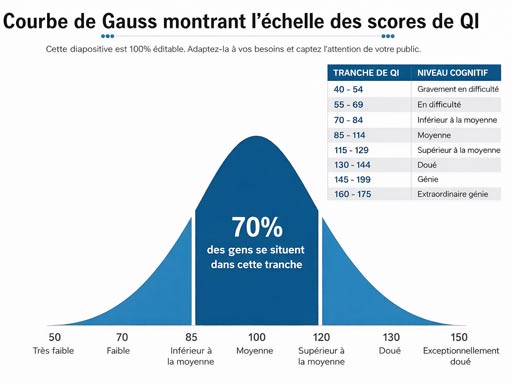
100 Average (Median)
σ 15 Standard deviation
68% Entre 85-115

Distribution du QI

Courbe de Gauss (Bell Curve)

insights
Courbe de Gauss montrant l'échelle des scores de QI
Rare (< 2.2%) Extremes
Courant (13.6%) Au-dessus/en-dessous
Very common (68%) Population centrale

Ready to discover your place in history?

Join the millions of individuals who have used these methods to better understand their intellectual potential and explore their cognitive abilities.

check_circle

info